
 USA: +1 415 256 4347
  Sign in

Question
The U.S. is now the largest producer of natural gas in the world. Over the past ten years, net production of dry gas went up from 18 to 27 Tcf. Most of the increase happened in shale and tight oil plays, which make up about 50% of today’s total natural gas production. As production continues to increase and exceeds consumption, the U.S. will turn into a net exporter of natural gas. This change is expected to occur sometime between 2017 and 2018, and promises to have significant economic and political implications for the country and its trading partners. On balance, conditions for U.S. natural gas exports are favorable, but there are challenges to overcome, particularly in the short-term. In order to materialize any natural gas export, the Department of Energy and the Federal Energy Regulation Commission in line with the Natural Gas Act have to authorize natural gas export. However, exporting natural gas is likely to heighten pressure on the domestic prices, and additionally, the decision to export has significant impact on the US relationship to its key allies including KSA and Qatar and its relationship to the OPEC as well. The intensity of competition among oil-and-gas producing countries is likely to result in price wars that may lead to severe decline in profit margins. Additionally, US relationship with its allies in the MENA region, chiefly, KSA needs to be refocused beyond the oil-importing factor to include the fight against Islamic terrorism and MENA regional stability.
Write a brief option policy paper on how the US should take onboard a policy of exporting its natural gas as part of its foreign policy agenda, provided that international oil-and-gas pricing supports production and distribution. The paper should include a one-paragraph summary of the issue, followed by a page and half problem analysis on its background and its context including exiting evidence: how does this issue relate to other issues currently under considerations? What would the options look differently if the context of the issue were presented differently? The reminder is dedicated to detailing 3 policy options to consider including pros and cons, to describe the probabilities that cost and benefits of the options will be realized and how sensitive these options are to changes in the assumptions, and to conclude by recommending one option including its justification. The recommendation should lead to a decision to be made.
The attached, uploaded materials will provide you with the necessary academic, scholarly body of work.
Answer
Exporting Natural Gas: USA
Since 2009, the US has been the leading global producer of natural gas (Cordesman, 2016). By 2015, natural gas had become the second-largest source of energy in the country (Cordesman, 2016). Despite the strong and short-term projections, the US natural gas industry continues to struggle under the current oil crisis, the OPEC strategy to cut production, and the growing capacity of other countries to produce natural gas. This policy paper will outline these rising challenges involving pricing, sustainability, and its relations with partners such as Qatar and Saudi Arabia. In addition, it will consider alternative policies that can be applied to deal with this situation as well as other connected areas of Islamic terrorism and stability in the MENA region.
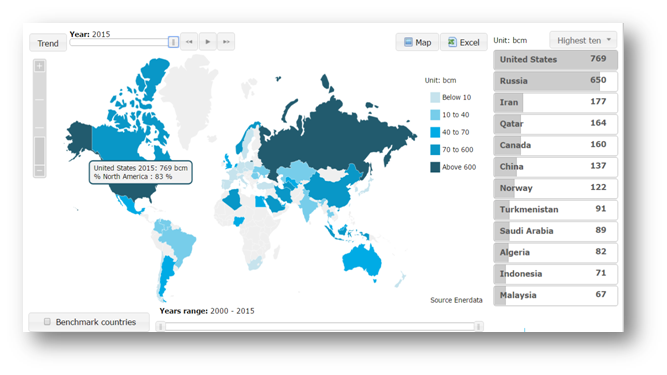
Fig. 1: A chart showing America’s position as the world’s leading producer of natural gas, with quantities being shown in billion cubic meters (bcm) (Source: Global Energy Statistical Yearbook 2016)
Current activities and structures within the EU, Russia and Ukraine are growing influencers on the oil and gas industry more so in regards to the pricing. Currently, OPEC is observing pricing trends after the oil production reduction was issued for OPEC members and several non-members (Cordesman, 2016). While OPEC will reconvene to monitor growth, if any,in May, it is unclear as to whether this move will lead to an increase in oil prices. Ultimately, the outcome of this project and an OPEC goal of reducing oversupply believed to be caused by the US will affect the growth or stability of natural gas export, domestic use and combined pricing. As so, the policies developed will consider the US standing as well as international and external influencer that continue to highly affect the global oil and gas sector.
There is no doubt that the US has by far become less dependent on energy imports especially from the Persian Gulf. Even though different stakeholders and researchers still find varying discrepancies in the methods used to determine the dependency ratios, there is truly no doubt that the US has progressively become more independent in its energy requirements (Ladislaw, 2016). It is equally true that the US has become less prone to global or international economic instabilities by continually working towards establishing an independent economy that is self-supporting. Nowhere is this phenomenon observed more strongly than in security matters. Amid growing insecurity and terrorism, the US has focused on the fight against modern terrorism that is less focused on anarchism and more on fundamentalism. Ideally, terrorism based on religious alliances or alignments is not a sustainable form of terrorism. Modern terrorism utilizes this religious dynamism to implement ideological or fundamentalist goals of groups and countries. Ultimately, globalization has paved way extreme nationalism through instruments of trade, politics, regional units and distribution of resources. In comparison, some of the leading exporters of oil and natural in the Gulf region spend large amounts of this revenue and infrastructure on military reinforcement and armory from the US to the point of teetering on the brink of economic instability (Crane, Knopman, Burge, Powers, and Willis 2016). In these early years of the 21st century, the US has been more focused on strengthening its security with a keen focus on the Middle-Eastern region (Hughes, 2014). Today, the US has redirected this focus by strengthening its borders against global threat.
ORDER A POLITICAL SCIENCE PAPER NOW
As the security and insecurity dilemma continues to persist in countries like Syria, the effects are bound to be experienced globally. The US, though becoming growingly independent from Russian and Gulf energy, will equally bear the implications of these emerging trends. It is incorrect to assume that the US is largely immune to global politics and oil structures.
Even so, current debates and controversiesare centered mainly on the effect of increased export of natural gas. While most gas was initially obtained from single gas and oil reserves, shale gas has boosted the quantity and has shifted the concentration of gas exploration to this direction. The growing nature of shale exploration continues to face huge criticism from environmental groups. Besides, environmental stakeholders hold great international influence and thus,cannot be dismissed. Federal support offered to these groups has also expanded their strength and capacities. Shale extraction uses fracturing method which has been linked to extreme effects like the poisoning of underground water reserves and the offsetting of tectonic earth movements on a global scale. America’s move towards increasing their exports will undoubtedly lead to the expansion of shale exploration and the increased risk of these definite hazards (BBVA Research, 2016).
Another growing concern has been the domestic fluctuation of gas prices as the country gears up towards becoming a net exporter. The US is increasingly positioning natural gas as a cheaper and cleaner energy alternative to the general population. Congress has expressed growing concernsregarding the effect it will have on these prices. With the main form of export being Liquefied Natural Gas (LNG), the Department of Energy has justified its approval by suggesting that the US will be able to support its export and domestic markets without altering the pricing (Morton, 2016). Furthermore, the DOE has stated that any increase in price will equal the growth of the economy and will only represent a true growth of employment, wages and consumer buying power.
The ongoing challenges for US despite making huge steps are the federal regulations, and the coordination of international LNG terminals. As it stands, most terminals are placed in countries that do not have Free Trade Agreements with the US. This thus requires numerous amendments of the constitution and natural gas Acts (Ratner, Parfomak, Luther and Fergusson 2015). The US continued strategy to become independent of Russian Energy is reflected on the US-Saudi Alliance that has ultimately led to sharp decline in oil prices. With the KSA flooding the global market with cheap oil prices, countries such as China have benefited from these reduced prices while Russia has been completely weakened. Yet this tactic reflects the strategy used in the 1980s to bring down the Soviet Union (Morton, 2016). This has been equally reiterated in the OPEC production reduction deal of which KSA has willingly participated. The reasons for this have been the expectations as its leading oil company moves towards privatization. At the same time, areas such as Iran, Iraq and Syria with Jordan and Lebanon in extension continue to fight, affecting the global oil industry. Common strategies will prove mostly unsustainable for the US.
One of the growing policies has been creating and enforcing new regulation over environmental concerns with LNG. While it is generally accepted that gas is cleaner burning energy alternative than coal or crude oil, environmental conservation groups continue to campaign for extreme regulation (Boersma, Ebinger, and Greenley 2015). The DOE has set out various reports which show that the use of gas in energy generation does not increase carbon emission on a cyclic level. While the fracturing method is indeed a negative component, it is equally linked to oil extraction (Morton, 2016). Limiting the export of natural gas will thus have little to no effect on the continued use of fracturing. In addition, the subsequent growing of oil in the US will expand alongside fracturing if LNG is completely ruled out. Without a doubt, oil is way heavier and has more carbon emissions on the atmosphere. An environmental obligation policy should be enforced to promote the integrity of these natural gas companies as well as the environmental organizations (BBVA Research, 2016). It is also widely known that such groups are also heavily influenced by opponents who may have economic agendas of their own.
As the DOE continues to analyze more export proposals, public interest remains a key influencer in this export business. At this point it is inevitable that domestic prices will rise with increase in exports. The main influencing factor that has gained political attention is the foreign leverage that LNG export will provide for the US. However, global regulators and OPEC also have to intervene and ensure that this growing export does not become well established at the expense of global markets and global stability especially in the Gulf region. While the US has undoubtedly implemented strategies to weaken Russia and Chinas role in the energy sector, many now fear that this is being done at the expense on other countries (BBVA Research, 2016).
The EU has been directly linked to the Ukraine-Russian crisis that continues to weaken Russia and to cause more economic struggle for the country. In result, Ukraine may be forced to align to the EU and not Russia as it intends. International organizations have to move towards policies that are globally-oriented (BBVA Research, 2016). While this is very difficult, the OPEC and concerned non-members should focus on the global pricing of oil at a rate that allows for fair growth. In this particular situation, the EU and the US must completely step away from directly influencing Ukraine on the position they should take and allow the country to make a decision based on its own requirements and preferences (BBVA Research, 2016). The DOE has a responsibility of increasing transparency and eliminating the power of oil networks that penetrate as deep as the Wall Street and control oil derivatives through such subjects.
Finally, emerging policies have to be founded in the American people and the sustainability of the public over individual companies or individuals. While LNG exports are bound to grow the country’s economic strength if prizes steadily rise, the US must cautiously move towards export with a clear vision on their competitors and global natural gas trends (ExxonMobil, 2016). While the primary pipeline routes and centers are in Canada and Mexico, it is likely that these are not sustainable mainly due to the countries’ growing energy productions. As an example, Canada’s oil sands hold one of largest potential reserves in the world, as is the newly discovered reserves in Angola and Brazil. America’s production economic growthbound to suffer in the short-term if gas prices increase. Ata time when the US is attempting to move towards local manufacturing as opposed to a China-based manufacturing process, the increase of gas prices may completely destroy these goals.
Overall, it is evident that the leading short term concerns surrounding export of natural gas include environmental concerns, domestic prices and foreign policies with the Gulf region as well as other emerging energy regions. Each of the policies involved value transparency and the preservation of the American population and industries. In extension, the government concentration on Gulf region politics is bound to have long-term effects amidst the constant restructures and alliances that happen in the region. The Middle Eastern and North African countries continue to form alliances and networks that will ultimately allow for a united Eurasian front that may intern negatively affect the US export goals. Under the new administration, it remains uncertain on the foreign policies involving this region and Russia. In regards to environmental goals, it is more sustainable to focus on a move towards even cleaner sources of energy such as solar and wind energy.
References
Cordesman, A. (2016). The Myth of US Energy Independence and the Realities of Burden Sharing.Washington, DC: Center for Strategic and International Studies.
Global Energy Statistical Yearbook (2016). Natural gas production. Web.
Hughes, L. (2014). The Limits of Oil Independence: Assessing the implications of oil abundance for US foreign policy. Energy Research and Social Science.
Crane, K. Knopman, D. Burge, N. Powers, J. and Willis, H. (2016). Scenario Development for 2015.Quadrennial Energy Review. New York, NY: RAND.
Ladislaw, S. (2016). US Election Note: Energy and Climate Policy after 2016. London: Chatham House.
Pasquale, M. (2016). Could US Oil and Gas exports be a game changer for EU energy security? Directorate General for External Policies-European Union.
Ratner, M. Parfomak, P. Luther, L. and Fergusson, I. (2015). US Natural Gas Exports: New Opportunities, Uncertain Outcomes. Washington, DC: Congressional Research Service.
Morton, R. (2016). The Nixon Administration Energy Policy. American Academy of Political and Social Science.
Exxon Mobil. (2016). The Outlook for Energy: A View to 2040. ExxonMobil.
Boersma, T. Ebinger, C. and Greenley, H. (2015). An Assessment of US Natural Gas Exports. Washington, DC: Brookings Natural Gas Task Force.
BBVA Research. (2016). US Natural Gas Exports: A Reliable Source of Energy to the Rest of the World. US Economic Watch, 29 July, 2016.


