
 USA: +1 415 256 4347
 Sign in


Property Law
Series of Ownership
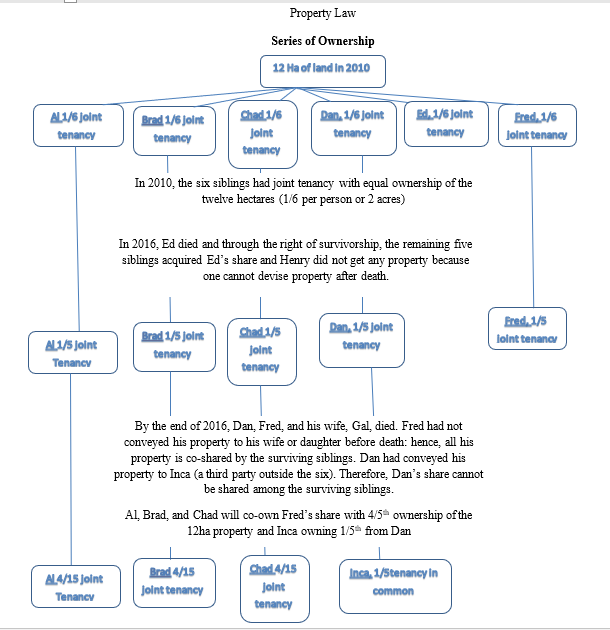
According to section 39 of the Conveyancing and Law of Property Act of 1994, parties, including companies, can enter into a joint tenancy provided there are no words or severance to indicate a specified share of the property. In the case study above, all the six siblings entered into a joint tenancy in 2010 when they purchased the 12 hectares property and built individual residential houses. The joint tenancy gave each of the siblings equal ownership of the property: hence, the 1/6th ownership in 2010. When Fred married Gal in 2014, he did not convey his property to his wife Gal, or their daughter, Kim. Therefore, Fred did not sever the joint tenancy and each of the sibling maintained equal ownership in 2014 of a 1/6th of the property. According to Crown (2011), a joint tenancy can be severed when one of the co-owners transfers or conveys property to a third party, which results in tenancy in common. However, Fred has not been reported to have conveyed his property to either his wife or the daughter Kim. (Law paper)
However, in 2016, Ed died and devised his property to his only child Henry. However, under the principle of joint tenancy, a co-owner cannot devise his/her property after death (Crown, 2011). Thus, all of Ed’s property was acquired by the surviving siblings under the Right of Survivorship. According to Conway (2008), the Right of Survivorship in joint tenancy holds that once a co-owner dies, the surviving joint tenants acquire the property of the deceased irrespective of the presence of a will. Similarly, when Fred and Gal died in 2016, Kim, their daughter, could not have inherited Fred’s property because she was not a joint tenant and Fred had not conveyed his share to her. Fred’s property became the property of the surviving siblings. Dan also died the same year and before his death, he had conveyed his interests to a third party, Inca. Dan’s actions severed the joint tenancy and generated a tenant in common. Inca is, therefore, not entitled to co-share with the other siblings and Inca’s share is only what belonged to Dan.
References
Conveyancing and Law of Property Act (1994)
Conway, H. (2008). ‘Leaving Nothing to Chance?’: Joint Tenancies, the ‘Right’of Survivorship, and Unilateral Severance. Oxford University Commonwealth Law Journal, 8(1), 45-92.
Crown, B. C. (2011). En Bloc Sales And Joint Tenancy: Goh Teh Lee v. Lim Li Pheng Maria. Sing. J. Legal Stud., 564.


